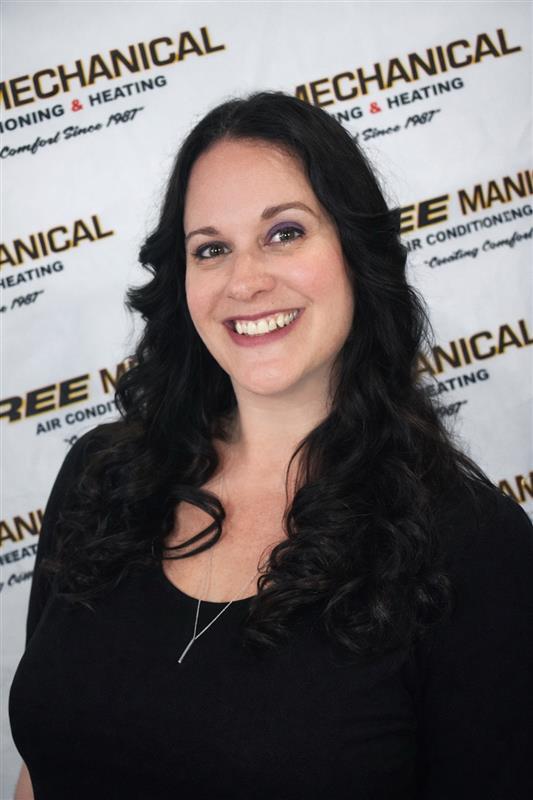
Kelly Purcell
Installation Director
Kelly oversees installs from start to finish. Her specialty is permitting: most California permits are issued city by city, not county by county, and she is our go-to for getting them.

Service pillar
Planned commercial equipment change-outs and retrofits at end of life: rooftop units up to 100 tons, split systems to 60 tons, and cooling towers, to local city and state code.

Your install team
From permit to start-up, these two run every replacement and install.
Installation Director
Kelly oversees installs from start to finish. Her specialty is permitting: most California permits are issued city by city, not county by county, and she is our go-to for getting them.
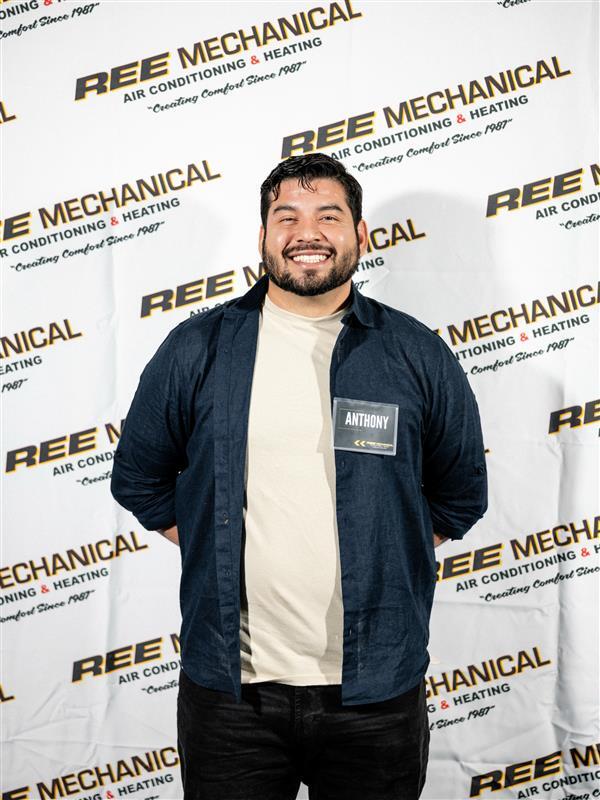
Install Foreman
Anthony leads a team of technicians dedicated entirely to installation.
7 service lines
HVAC Installation & Replacement at REE Mechanical Inc. covers 7 service lines, including Evaporative Cooler Installation & Replacement and Hydronic Fan Coil Installation & Replacement. Each card below opens its scope, process and coverage.
Two jobs: installing equipment a building never had, and replacing equipment that has failed or worn out. REE Mechanical Inc. handles rooftop units up to 100 tons and split systems up to 60 tons, to local city and state codes.
Most commercial installation work happens in buildings that are open for business. A remodel adds sales floor. A tenant improvement splits a suite. A rooftop unit finally gives out in July. The equipment changes from job to job, but the planning questions stay the same: who owns the permit, where the crane sets up, whether the new unit lands on the old curb, and what keeps the site cool if the equipment arrives late.
Installation adds capacity for a new site, an expansion, or a tenant improvement. Replacement retires equipment at end of life or after a major failure. Plenty of projects are both, like a larger unit after a remodel.
| Project | What starts it | What the scope turns on |
|---|---|---|
| New site or build-out | A shell building fitted out for a tenant, or newly conditioned space | Load calculation, structure, utilities, and code for new work |
| Added capacity | Tenant improvement, a new IT closet, or higher occupancy | Whether existing equipment can carry the load or the space needs its own |
| Planned replacement | Age, repeat failures, phased-down refrigerant, or rising energy use | Curb fit, code changes since the original install, budget year, and lead time |
| Failure replacement | A compressor, coil, or heat exchanger failure late in a unit’s life | Equipment availability, temporary cooling, and trading hours |
We install and service commercial equipment from these manufacturers across our Southern California and Arizona sites:
Brand choice for a replacement follows the site: curb fit, what the rest of the portfolio runs, and current lead times.
Replace when an old unit loses a major part, when its refrigerant is being phased down, or when it has become a regular line on the emergency spend report. Young units with minor failures are usually repairs.
Commercial equipment is commonly planned on a service life in the mid-teens of years, but that is a planning number, not a promise. Equipment ages with its environment, how hard it runs, and how well it has been maintained. A coastal store breathing salt air and an inland store with 110°F afternoons will not wear out on the same calendar. A contactor on a ten-year-old unit is a repair. A third compressor on the same unit is a replacement conversation. For a worked framework on packaged equipment, see repair or replace a rooftop unit.
Five things: the permit, the curb, the crane, the lead time, and the phasing. Settle them first and the change-out happens on a planned date. Leave them open and the site waits between demolition and start-up.
Permits. Kelly Purcell, our Installation Director, runs our installations, and permitting is her specialty. That matters here because most California permits are issued city by city, so a portfolio spread across six counties means a long list of building departments. Check current code with each jurisdiction rather than assuming an old approval still applies.
Curbs and structure. New equipment rarely matches the footprint it replaces. An adapter or a new curb brings roofing work and sometimes a structural review, which is far easier to plan than to discover on crane day.
Crane and access. Crane size, reach, and staging set the date as much as the equipment does. Lot or street closures, overhead lines, and the store’s trading calendar all belong in the pick plan.
Lead times. They vary by size and type. Confirm them before a demolition date goes on anyone’s calendar.
Phasing. Large jobs split into stages — one unit, one roof section, or one floor at a time — so the building keeps operating around the work.
Our own people. Kelly Purcell directs installations and permitting. Anthony Renteria, our Install Foreman, leads a team dedicated to installation. Jessica Bresciani, our Estimating Operations Lead, turns what the survey finds into a quote you can take to budget.
We self-perform the work with factory-trained, EPA-certified technicians instead of passing it to a subcontracted network. REE Mechanical Inc. is licensed, bonded and insured, holding CSLB C20 licenses #940700 and #526944 in California and Arizona ROC #365042. Our special projects team has the experience and knowledge to complete a replacement or retrofit to local city and state codes. Three commitments shape how every job is scheduled and documented: Minimize Disruption, Eliminate Red Tape, and Built to Adapt.
Run replacement as a program with a budget, not a string of emergencies. Evaluate every asset, rank units by risk and by what a failure would cost each site, assign budget years, and schedule the work in shoulder seasons.
At a Southern California site, the store keeps trading on temporary cooling. REE Mechanical Inc. can arrange it through our Herc Rentals relationship until the new unit is set and started.
See temporary cooling rental and setup, and for planning ahead, temporary cooling when equipment is on backorder.
Across 21 counties in two states: Ventura, Los Angeles, Orange, San Bernardino, Riverside, and San Diego counties in Southern California, and all of Arizona. We are family-owned since 1987 and headquartered in Temecula.
Arizona is an active, growing market for us under our new ROC license, and we take installation work anywhere in the state. See all service areas, or start with Riverside County or Los Angeles County.
Keep them on a maintenance program so they reach their full service life. By our own count, roughly 80 percent of the service calls we run could have been avoided with proper maintenance.
We also estimate that HVAC&R accounts for about 60 percent of a site’s electrical energy, so a neglected unit costs money every month it runs, not only on the day it fails. See HVAC maintenance and inspections, and tie new equipment into HVAC controls from the day it starts up. To schedule an asset evaluation, call (800) 742-0910 or send us your site list.
More answers on scope, coverage and scheduling are on our commercial HVAC FAQs page .
Questions
Commercial HVAC equipment is commonly planned on a service life in the mid-teens of years. Actual life depends on climate, run hours, and maintenance, which is why we evaluate assets and advise which units are likely to need replacement sooner rather than later.
REE Mechanical Inc. installs and replaces rooftop units up to 100 tons and split systems up to 60 tons, along with water-source heat pumps, hydronic fan coils, ductless mini splits, make-up air and exhaust equipment, evaporative coolers, and building management systems. We do not work on chillers.
Kelly Purcell, our Installation Director, runs permitting. Most California permits are issued city by city rather than by county, so a multi-site project often involves several building departments with their own requirements.
For Southern California sites, REE Mechanical Inc. can arrange temporary cooling through our Herc Rentals relationship so the site keeps trading until the new equipment is set and started.
For most retail sites it should be. Crane picks, roof work, and indoor ceiling work are planned around the store calendar, and large projects can be phased so the building keeps operating.
Call REE Mechanical Inc. at (800) 742-0910 or send us your site list.
Monday - Friday: 7:00 AM - 4:00 PM · 24/7 emergency dispatch
Choose a lane