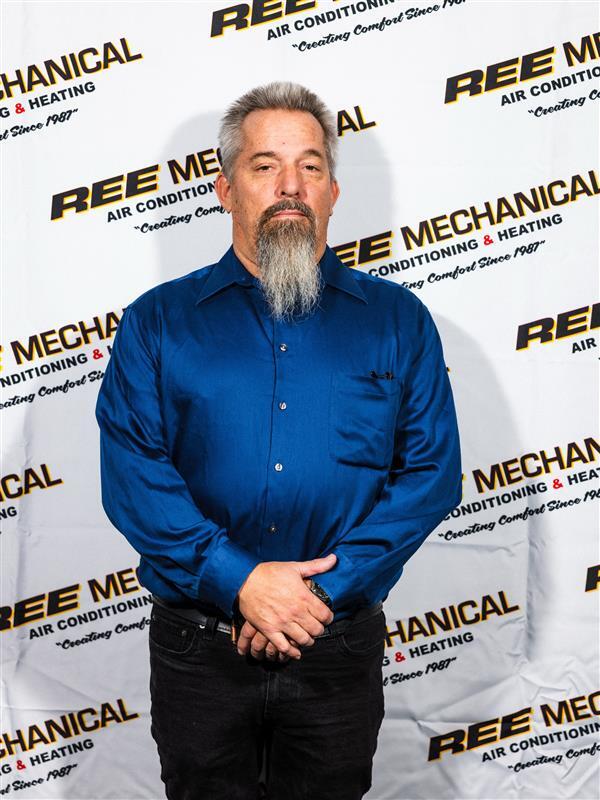
Michael Herbranson
Training and Safety Director
Mike trains our technicians to deliver top-notch PMs that prevent unnecessary system failures. He has spent more than 15 years at REE, from service technician to Training and Safety Director.

Service pillar
Planned commercial maintenance programs and Standard 180 inspections, built per site to ANSI/ASHRAE/ACCA Standard 180, because roughly 80% of the service calls we receive were preventable.

Your PM team
Preventive maintenance is our bread and butter. These two make sure every visit is done right and done on schedule.
Training and Safety Director
Mike trains our technicians to deliver top-notch PMs that prevent unnecessary system failures. He has spent more than 15 years at REE, from service technician to Training and Safety Director.
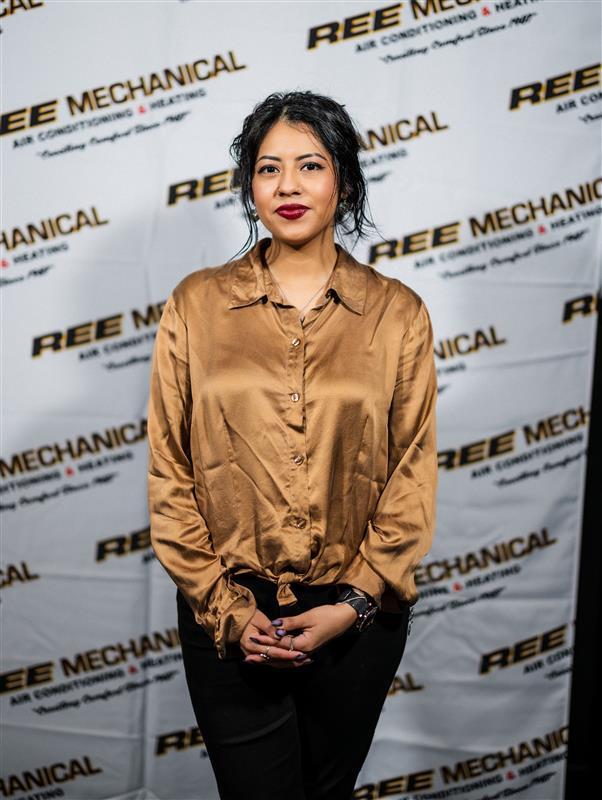
PM Operations Lead
Cindy leads PM operations, keeping every scheduled maintenance visit on the calendar and every site's program on track.
11 service lines
HVAC Maintenance & Inspections at REE Mechanical Inc. covers 11 service lines, including HVAC Maintenance & Tune-Up in San Diego County and HVAC Maintenance & Tune-Up in Riverside County. Each card below opens its scope, process and coverage.
A commercial HVAC maintenance program is a scheduled, documented set of inspections and service tasks written for each site's equipment. REE Mechanical Inc. builds every program to ANSI/ASHRAE/ACCA Standard 180.
Each program includes only the tasks a facility actually needs.
Standard 180 is the National Standard Practice for the Inspection & Maintenance of Commercial HVAC Systems. It sets what gets inspected, how often, and what gets written down. That written record is the difference between a maintenance program and a filter route.
Our programs cover the equipment multi-site portfolios actually run: packaged rooftop units up to 100 tons, split systems up to 60 tons, heat pumps and water source heat pumps, VAV boxes, economizers, make-up air and exhaust, unit heaters, air curtains, and controls. Chillers are outside our scope.
Because most failures can be avoided. By our own count, roughly 80% of the service calls we receive could have been prevented with proper maintenance.
Each of those calls is a repair bill, a disrupted trading day, and a unit wearing out ahead of schedule.
Energy is the other half of the case. HVAC&R systems account for about 60 percent of a site’s electrical energy use, so dirty coils, slipping belts, and a stuck economizer reach the utility bill long before anyone files a comfort complaint.
“When systems are not maintained, indoor air quality, occupant comfort and energy efficiency all suffer.” — Robert Baker, Chair of the committee that wrote Standard 180
| Running call to call | Running a planned program | |
|---|---|---|
| When work happens | After a unit fails, often in the middle of a trading day | On a calendar set around each site’s hours |
| What you know about the fleet | Whatever the last service ticket says | A record for every unit, updated at every visit |
| Replacement | Bought as an emergency | Forecast from condition findings and budgeted ahead |
| Energy use | Drifts upward as coils foul and economizers fail | Held closer to design by routine coil, filter, and controls work |
Start with the sites that already cost you the most: repeat breakdowns, missing equipment history, rising utility bills with no change in use, or inland and desert stores heading into summer without a spring visit.
We customize each plan to the site’s schedule, installed systems, and budget. Tasks vary from site to site, and nothing goes on the list that the equipment does not need.
That matters in a region with this many climates. A coastal store in Oxnard and an inland store in Riverside can run the same rooftop unit and still need different task weights and different intervals. Structuring a program correctly takes knowledge of those local climates, and that regional experience is what we bring.
The people on your roofs are our own technicians, not a subcontracted network, and every one of them is EPA certified. Mike Herbranson, our Training and Safety Director, has been with REE for more than 15 years and trains our technicians on how PM visits are performed.
Every program is tailored to the equipment installed at each site, but this is the task library our technicians work from on a standard commercial HVAC maintenance visit. Inspection tasking is also performed during annual services.
Cindy Buzzelli, our PM Operations Lead, keeps every scheduled maintenance visit on the calendar and every site’s program on track. She is your point of contact for setting up or adjusting a preventative maintenance program — meet Cindy.
We run programs across Ventura, Los Angeles, Orange, San Bernardino, Riverside, and San Diego counties and throughout Arizona: 21 counties in two states, managed from our headquarters at 42245 Remington Ave B10.
California work is performed under CSLB C20 licenses #940700 and #526944, with Jonathan Evancik as qualifying individual. Arizona is an active and growing market for us, served under our new Arizona ROC license #365042. REE Mechanical Inc. is licensed, bonded and insured, and has been family-owned since 1987.
Each county has its own maintenance profile: Ventura County, Los Angeles County, Orange County, San Bernardino County, Riverside County, and San Diego County. Full coverage is on our service areas page.
We are on call 24/7, and the site file a program builds is what makes an urgent visit work.
Priority accounts get a technician on site within 4 hours once site documentation and roof access are in place (actual arrival varies with location and conditions). Our technicians are based across Southern California and Arizona instead of dispatched from a single yard. Breakdowns between visits are handled under HVAC repair and emergency service, and findings from those calls go back into the same equipment record.
Send us the site list. We scope the program against it one site at a time, and Cindy puts the first visits on the calendar.
Call (800) 742-0910 or reach our office. The services inside a program include preventive maintenance and tune-ups, filter and belt maintenance and tune-up, and coil and condenser maintenance and tune-up.
More answers on scope, coverage and scheduling are on our commercial HVAC FAQs page .
Questions
Every program is built to ANSI/ASHRAE/ACCA Standard 180, the National Standard Practice for the Inspection & Maintenance of Commercial HVAC Systems. It defines inspection tasks, intervals, and the records that show the work was done.
In our experience, about 80% of the service calls we receive could have been avoided with proper maintenance. HVAC&R also accounts for roughly 60 percent of site electrical energy use, so a maintained fleet protects the utility budget as well as the repair budget.
Different sites should have different programs. Equipment, run hours, and climate vary from one site to the next, and Southern California alone packs coastal, inland, and desert conditions into one region. We write each task list for the equipment installed at that site.
Rooftop packaged units up to 100 tons, split systems up to 60 tons, heat pumps, water source heat pumps, VAV boxes, economizers, make-up air, exhaust, unit heaters, air curtains, and controls, from any manufacturer. We do not service chillers.
Cindy Buzzelli, our PM Operations Lead, keeps every scheduled visit on the calendar and is the contact for setting up or adjusting a program. Call (800) 742-0910 and ask for Cindy.
Call REE Mechanical Inc. at (800) 742-0910 or send us your site list.
Monday - Friday: 7:00 AM - 4:00 PM · 24/7 emergency dispatch
Choose a lane